The losses that hurt most rarely trip a fixed alarm. A diverted truck, a door opened at 2 a.m. or a reefer quietly cycling can all stay inside your limits until it is too late. Smart alerts learn what normal looks like for each shipment and flag what is not, with nothing to set up.

Theft is often spotted only after the load has gone.
A fixed light limit either misses door openings or sends a stream of false alarms.
Spoilage can stay within your limits until the product is already lost.
A fixed limit only tells you when one reading crosses one line. A diverted truck, a door opened at night or a reefer switching on and off can all slip past it. Smart alerts look at the pattern instead, so you hear about these risks while there is still time to act.
A shipment leaving its usual route is often the first sign of theft. Tive learns the expected routes for each lane from past journeys and alerts you when a shipment travels on roads it would not normally use. There are no routes to draw or corridors to maintain.

A fixed light limit cannot tell daylight from a door opening, so it either misses tampering or sends a stream of false alarms. Smart light alerts learn recent light levels during the day and lower the limit after dark, so an opening at 2 a.m. is caught and normal daylight is ignored.
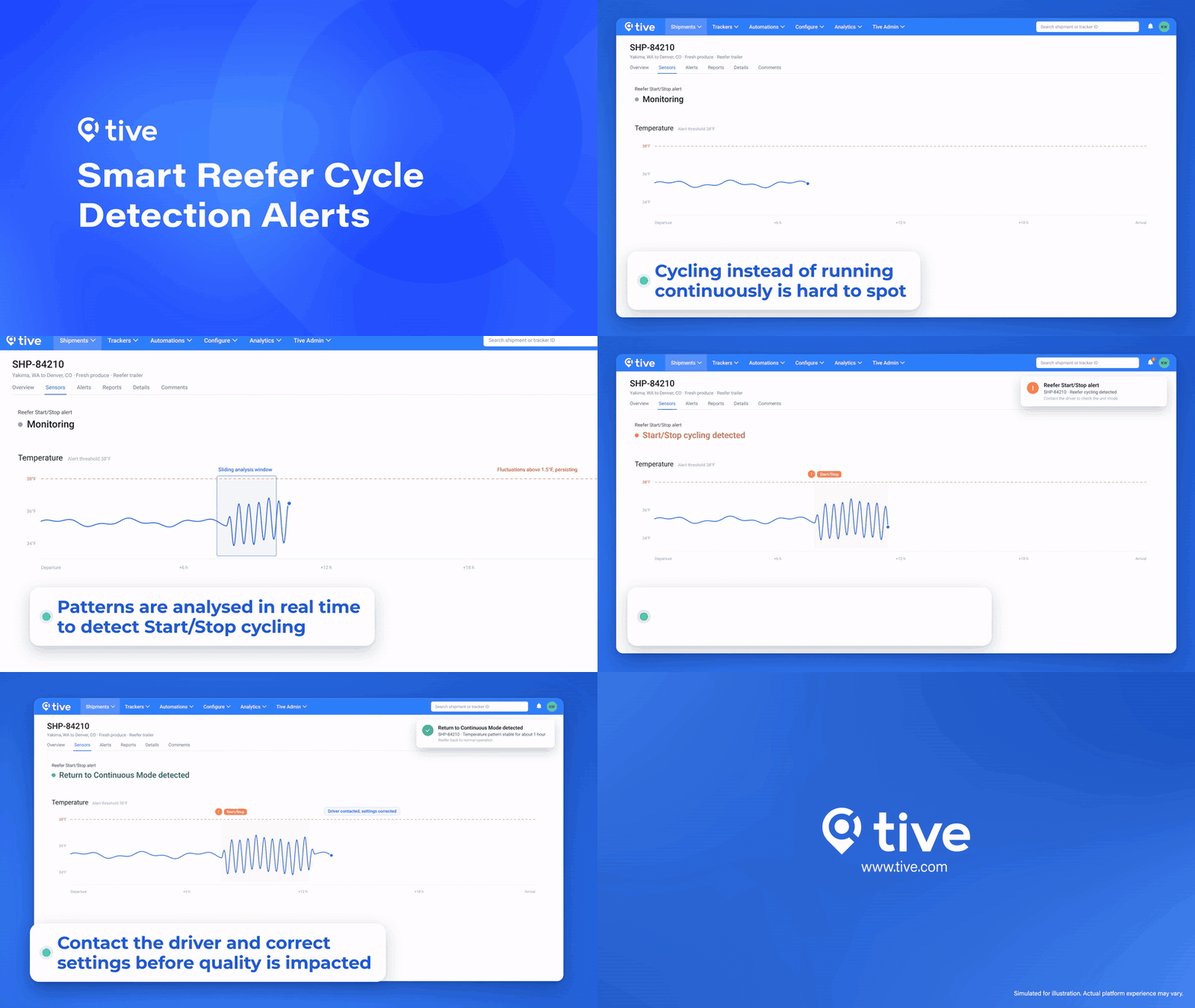
A reefer set to cycle switches on and off, letting the temperature inside drift. It often stays within limits until the product is already at risk, so a standard alert never fires. Tive analyses the temperature pattern in real time and flags start/stop cycling, so you can ask the driver to correct the setting before quality is affected.
A stolen copper shipment was recovered within hours after a covert tracker showed the load 400 miles off course.
Combines several signals, such as light, temperature and third-party risk data, to make it harder for a theft to go unnoticed.
How is a smart alert different from a standard alert?
A standard alert fires when a reading crosses a limit you set. A smart alert learns what is normal for the shipment, such as its usual route or light levels, and flags behaviour that does not fit, even when no fixed limit is crossed.
Do smart alerts need setting up?
No. Expected routes and light levels are learned automatically. You can still use your own limits alongside them.
What is reefer cycling?
It is when a refrigeration unit switches on and off instead of running continuously, which lets the temperature inside the trailer drift.
See smart alerts working on shipments like yours.

