

The Cold Chain Doesn't Break in the Freezer. It Breaks in the Gaps.

July 22, 2026
September 21, 2026
x min read
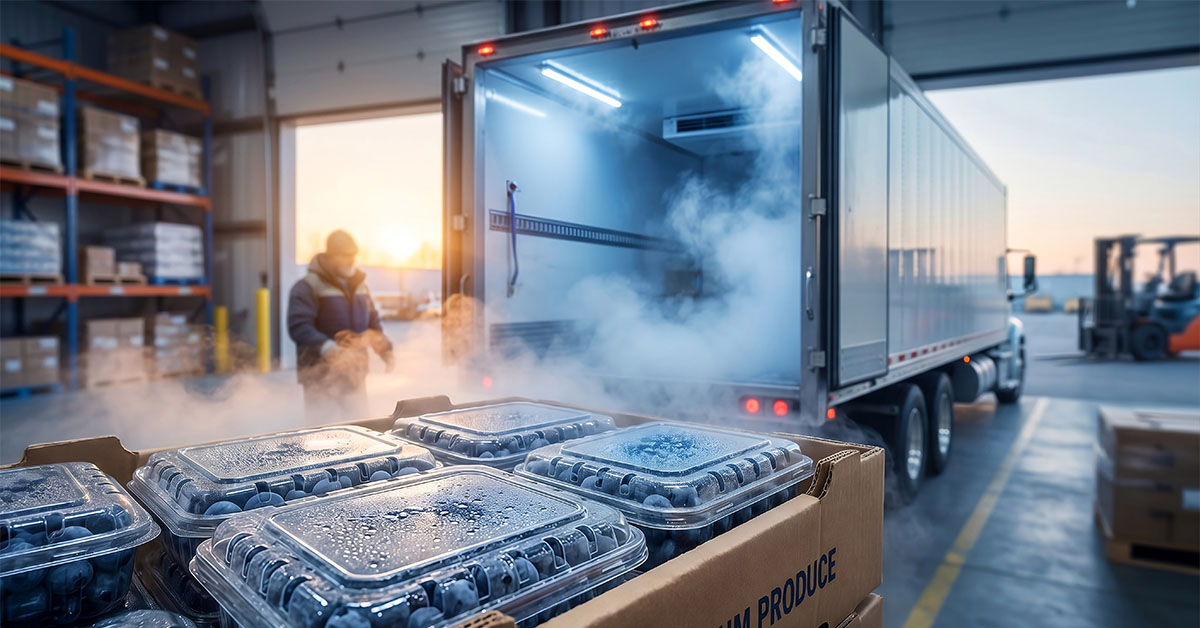
The freezer gets all the attention in the cold chain. It has alarms, backup power, temperature checks, and enough expensive equipment around it to make everyone nervous. Ironically, though, it’s usually the most reliable part of the trip.
Loads tend to go bad in much quieter places.
A pallet comes off one truck and waits 90 minutes for the next. The first tracker has already been shut down. The second hasn’t come online. It’s sitting on a cross-dock in July, soaking up heat while every system involved assumes another system’s watching it. By the time the load moves again, the top layer is warm and the tracking screen still shows a perfectly ordinary handoff.
That screen can tell you about a shipment's location… but it can't tell you anything about its condition. You will not know if the reefer stopped two hours ago, the doors stayed open too long, or a customs hold pushed the product past its safe window. A cold chain monitoring solution closes that gap by tracking condition instead of just location.
The fact is, companies in the supply chain have gotten very good at following freight, but are still playing catch-up when it comes to knowing what the freight is going through, not to mention the blind spots that tend to make the cold chain come apart.
What Happens on the Dock
The dock is the natural place to start, because it’s one of the first blind spots a cargo load encounters and can be one of the easiest to overlook. A reefer can hold temperature beautifully while the freight is inside it. Once that pallet comes off the truck and waits to be loaded onto the next one, the protection leaves with the trailer.
Maybe the handoff takes 90 minutes instead of 20. Perhaps the next trailer wasn’t precooled. Or the freight sits in the yard while the first tracker has already been removed from the load, and the next one hasn’t yet been activated. From the dock office, it looks like an ordinary delay between scans. Out in the yard, the product is spending longer than planned without temperature protection and may already be warming.
Anyone who’s worked a dock has seen some version of it. Buildings can have excellent sensors on both sides of the transfer, yet the yard between them is practically invisible. The tracking record has the same missing piece. It shows the load leaving one controlled environment and arriving at another, but says very little about what happened during the stretch that may have done the damage.
Handoffs Are Where the Cold Chain Goes Dark
The handoff is worse, and it's everywhere in a multimodal move. Every time your freight changes carriers, the thread drops. Carrier systems only report on events, so the second it leaves one carrier's hands, their updates go quiet. Whatever happens next, whether at a transfer dock or during a customs hold that drags on, nobody is recording the temperature or owning it.
In 2026, this has become an even bigger problem because the freight market is experiencing more issues than normal. Reefer rejections are running about double last year's, so loads you thought were locked keep dropping into the spot market and getting covered by carriers you've never used. Each one means another handoff, and another blank spot you can't explain when a claim shows up.
And being able to explain it is worth real money. E.T.H. Cargo, a pharma 3PL, negated a bad damage claim by showing one of our trackers read -19.67°C the entire trip, which proved the load never left range.
In Air Freight, the Risk is on the Ground
Air freight pulls the same trick on the cold chain. Everybody frets about the flight going well, and meanwhile, the flight is usually the safest leg of the trip. Trouble awaits on the ground, on a hot apron, or in a cargo shed, which is exactly where a study that went and measured it found most of the temperature risk hiding.
Mostly it's about cargo sitting too long somewhere it shouldn't. A container unplugged during a port transfer drifts. Packaging rated for 48 hours gives up once a customs hold stretches the trip to 60 or 70.
By the time a 2-8°C load has spent four extra hours in a customs line, it might already be cooked… yet every scan still says it's in transit, calm as anything. Put a Tive tracker on the box, and catch it in real time.
Passive Loggers Tell You Too Late
Plenty of shippers figure they've got this covered because there's a logger in the box. A passive USB stick or NFC tag records everything, but you don't see it until you scan it at the destination. The data will tell you it went out of range, and you have nothing to do but file the claim.
Cold chain failures cost the pharma industry roughly $35 billion a year, and food waste is about the same, and most of it is lost in handoffs where the freight keeps moving but the data doesn't. Roughly one fifth of temperature-sensitive freight shows up damaged.
Real-time tracking flips that script. The alert reaches you while the load is still in transit, empowering you to start responding to temperature excursions before they turn into losses. Alpine Fresh saved a $120,000 load of blueberries and a $90,000 run of asparagus doing exactly that, by catching it mid-route. Passive loggers are like the fire report, whereas real-time visibility is the smoke alarm.
The Last Mile & the Receiving Dock
Even if the load survives all the handoffs with no damage, it can still be ruined in the last 20 miles. City docks are tight, and a QC guy at the door can reject the entire load on a hunch.
Produce is the most challenging to protect: its cold chain is usually one long string of handoffs, dwell nibbles at the shelf life, and the loss surfaces weeks later as a claim. Miss a beat, and you're eating ASN errors and OTIF penalties on top of spoilage.
Those penalties aren't hypothetical anymore. Walmart's traceability rules kicked in August 2025, and the chargebacks have been going out with a vengeance, in advance of the FDA’s 2028 deadline.
The simplest gap is between the data and the people who can use it. An alert does nothing if it doesn't reach someone in time to reroute or reject. Most shippers can't see that middle stretch at all, and it's the hardest part to fix.
We Built Tive for the Gaps
The problem with these gaps is that the freight keeps moving while the information gets left behind. A pallet can spend hours on a dock, in customs, or inside a reefer that’s slowly losing temperature, and nobody finds out until the customer opens the doors. Cold chain freight doesn’t pause while two carrier systems figure out whose turn it is to report.
Tive keeps the data moving with the freight. Our trackers stay with the load from pickup through delivery and continue reporting temperature and location as cargo changes carriers, waits out customs, and reaches the receiving dock. Your team maintains real-time shipment visibility across the part of the trip that carrier feeds tend to miss, so a rising temperature alert reaches someone early enough to change the outcome.
If the truck stops where it shouldn’t or strays from its route, your team can look into possible cargo theft before the shipment disappears. Our optional 24/7 Monitoring team can also watch high-risk loads after hours on your behalf, when a warning might otherwise sit untouched until morning.
The best way to see it for yourself? Put one of our trackers on a lane you lose sleep over, and watch what turns up. Get started with Tive today.


