

Real-Time Shipment Visibility, Updated: Introducing Our New Buyer’s Guide & ROI Calculator

March 6, 2026
September 21, 2026
x min read
Nobody wakes up excited to chase down a missing shipment. But if you’re running logistics for pharma, food, or anything high-value, it’s part of the job description. The second something goes awry in transit, it’s on you to figure out where it is, what happened to it, and who you need to call before it becomes a six-figure problem.
Real-time shipment visibility exists to keep you out of that scramble. But the harder question is which solution best fits your operation, and how you justify the investment to the people holding the budget.
At Tive, we just published two resources built around answering exactly those questions.
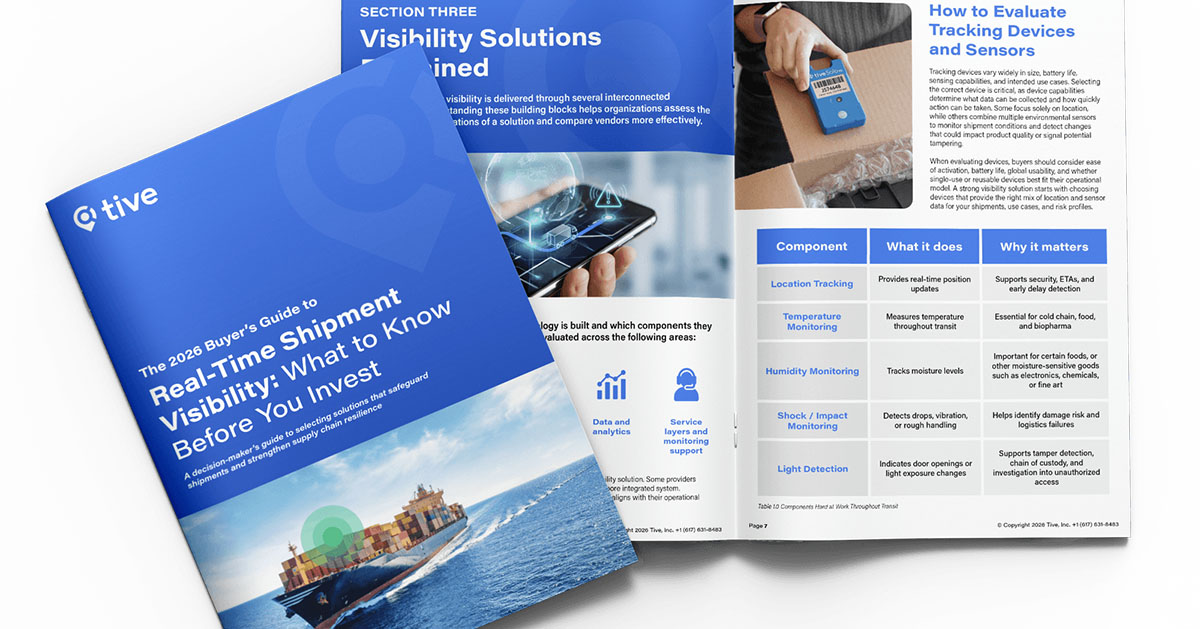
First up, Tive’s 2026 Buyer’s Guide to Real-Time Shipment Visibility. This interactive piece walks you through what solution to look for, what to compare it against, and what to ask vendors before you commit. Second up, our new interactive and fully customizable ROI Calculator lets you quickly plug in a few numbers and walk out with a business case grounded in your own personalized shipment data.
Below, we will pull out five buyer-ready takeaways from the Buyer’s Guide and show you how the ROI Calculator works, so you can pair the right criteria with real financial proof—and move forward with confidence.
5 Things to Know from the Real-Time Shipment Visibility Buyer’s Guide
Tive wrote the 2026 Buyer's Guide to Real-Time Shipment Visibility because we kept hearing the same questions from supply chain teams trying to evaluate visibility solutions. We wanted to give people a straightforward framework for cutting through the noise, whether buying for the first time or looking for a replacement.
Here are five things from the Guide worth a closer look before you start any buying conversation.
1. Your Blind Spots Are More Expensive Than You Realize
Sixty percent of organizations don’t find out about cargo damage until after delivery. Some never find out at all. Over a third can track the first and last mile but go completely dark mid-journey. We hear some version of that reality from nearly every team we talk to, and the pattern is always the same: problems compound silently in transit, and by the time anyone notices, the options have narrowed to filing a claim and calling the customer.
2. Knowing Location Alone Won’t Save You
Closing those blind spots starts with understanding that “Where is my shipment?” is only the first question. “What condition is it in?” matters just as much, sometimes more. A pharma load that arrives on time but experiences a six-hour temperature excursion mid-journey is a loss. The same goes for electronics exposed to humidity, or fragile goods that took repeated impacts nobody flagged. Our Buyer’s Guide makes the case that continuous condition monitoring for temperature, humidity, shock, and light exposure needs to sit at the core of any solution you evaluate, along with automated alerts and configurable thresholds.
3. Security Belongs in the Same Conversation
Once you’re monitoring conditions, folding in security is a natural next step. Cargo theft, pilferage, fraudulent pickups, route deviations: too many organizations still manage these through a separate program that never talks to their visibility tools. Our Guide argues that they should live together: the same sensors and location data that catch a temperature spike can also flag an unauthorized stop, a door opening at the wrong time, or a truck veering off its planned route. The key is pairing those signals with escalation paths that reach the right person fast enough to do something about it.
4. Evaluate the System, Not Just the Demo
All of that only works if the underlying technology stack holds up. We’ve heard stories about teams getting sold on one impressive feature only to discover months later that connectivity drops across borders, the platform doesn’t integrate with their TMS, and the analytics are too shallow to reveal root causes. The Buyer’s Guide breaks solutions into five layers: devices, connectivity, software, analytics, and services. We encourage teams to pressure-test how those layers perform together, because a great sensor attached to an unreliable network feeding a hard-to-use dashboard helps no one.
5. Build a Case, Not Just a Short List
Finding the right solution and getting it funded require two different skill sets. This Guide arms you for both by providing an interactive capabilities checklist, compliance guidance for regulated industries, and a vendor scoring worksheet. It also maps out what comes after the decision: scoping, carrier onboarding, pilots, alert design, training, and scaling. Then, once you’ve locked down what “good” looks like—technically and operationally—you have one last question to answer: what’s all this worth to the business?
That’s exactly what our next resource helps you answer.
The Tive ROI Calculator: What It Does and How It Works
You’ve completed the evaluation framework, and you now know what to look for in a solution and how to score vendors against each other. But none of that matters if you can’t answer the question your CFO or VP of Operations will inevitably ask: “What’s the return?”
We built our interactive ROI Calculator to help you answer that question. All it takes is plugging in information from your own operations in a quick step-by-step process.
Step 1: What Industry Are You In?
The ROI Calculator starts by asking what industry you’re in because the value of real-time shipment visibility looks different depending on what you’re protecting. You’ll select from Food & Beverage, Life Sciences & Pharma, High-Value Goods, Transportation & Logistics, or Other. Your answer will then help us tailor the output and recommend the right Tive solution for your operation.
Step 2: What Do You Need to Monitor?
Location, temperature, light exposure, shock, and humidity: check every box that applies to your shipments. This is important because a cold chain operation using real-time tracking to monitor temperature and humidity has a fundamentally different value profile than a logistics provider focused on location and security. Your selections keep the output honest to your operation, instead of defaulting to some industry benchmark that doesn’t reflect how you actually ship.
Step 3: How Many Shipments Do You Make Per Month?
This one is straightforward: simply plug in your average monthly shipping volume. The Calculator uses that number to scale savings estimates proportionally, so whether you’re shipping 50 loads a month or 5,000, the output stays relevant to your operation.
Step 4: What’s Your Estimated Monthly Loss From Shipment Issues?
Teams sometimes stall on this one, and we get it. Perfect accuracy isn’t the goal. Think about damages, theft, delays, quality rejections, and customer penalties. Add up what you can. A reasonable estimate beats leaving it blank, because ROI conversations fall apart fast when nobody agrees on what the problem even costs. Provide a starting point, and the Calculator does the rest.
Step 5: View Your Results
Four inputs in one minute, and you land on a results page tailored to your data. You’ll see monthly net savings, return on investment, annual savings, and a recommended Tive solution matched to your industry, monitoring needs, and volume. Print it, screenshot it, and drop it into a slide deck: whatever gets it in front of the people who need to see it. We designed the output to answer the exact question that stalls most buying decisions: “What’s this worth to us?”
Put Both Resources to Work
We built the Buyer’s Guide and ROI Calculator to solve two problems that usually slow teams down: figuring out what to look for in a real-time shipment visibility solution, and building a financial case strong enough to get it approved. The Guide gives you evaluation criteria, scoring tools, and a rollout framework. The Calculator turns your shipment data into projected savings you can bring to leadership. Together, they take you from research to a confident recommendation.
So, take the next steps now:
- Download the 2026 Buyer’s Guide to start your evaluation
- Run the ROI Calculator to quantify the value
And when you’re ready to talk specifics for your lanes and risk profile, we’re here to help you get started


.jpg)