

The Inside Track: Chips, Networks, Workflows, and AI: The Inevitable Transition to Autonomous Supply Chains

December 19, 2025
January 8, 2026
x min read
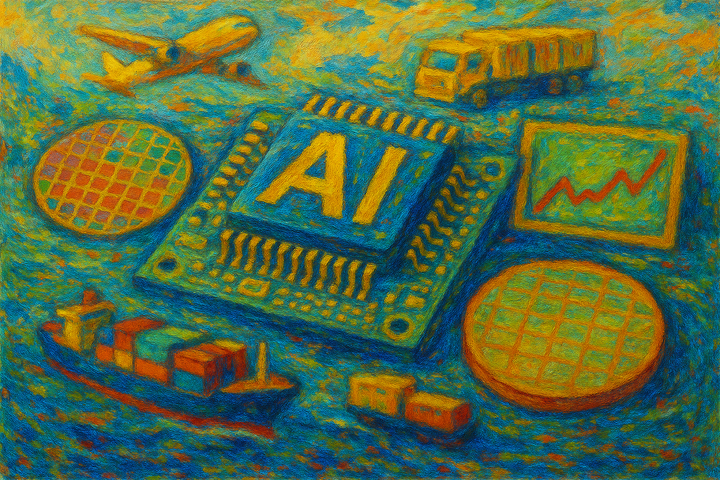
Semiconductor chips have become ubiquitous, embedded in everything from smartphones to drones to dishwashers to tiny IoT sensors. This growth has followed the trajectory of Moore’s Law, which predicted that the number of transistors on a chip would double roughly every two years. For decades, Moore’s Law drove exponential improvements in computing power and cost.
Now, there is a new law, which some call Huang’s Law (after NVIDIA’s CEO Jensen Huang): the performance of AI-focused chips is now doubling less than every 6 months, outpacing Moore’s original pace by 3–4x. In fact, Huang boasts that NVIDIA’s latest AI systems are progressing “way faster than Moore’s Law.” It’s an exciting time for everyone as chips have inevitably become the “brains” of IoT devices everywhere, following a combined Moore’s/Huang’s Law trajectory: always smaller, always faster, and always more affordable.
For the supply chain and logistics industry, cheaper and more powerful chips translate into affordable smart trackers and edge devices that can crunch data—or even run small AI language models right on the chips that are placed inside shipments and assets moving the cargo. We can clearly see that trend in the past decade with the proliferation of trackers in shipments and AI cameras on every truck driver’s dashboard. The driving force of CPUs, GPUs, and specialized AI chips is making real-time analytics and decision-making at the edge a reality, which is a foundational step toward autonomous supply chains.
Power & Batteries: Doing More with Less
Keeping all these devices running (for a long time) is just as important as making them more powerful. Fortunately, improvements in chip efficiency and battery technology are reducing power consumption per computation. Koomey’s Law observes that the energy efficiency of computing (work done per joule of energy) doubles roughly every 18 months. In other words, for the same battery life, you get twice the computing done as compared to a year and a half prior.
This trend has big implications: IoT trackers and sensors can run longer on a single charge, and novel power solutions are becoming feasible. We’re even seeing the rise of exotic, non-lithium batteries and energy-harvesting approaches for IoT. For example, alternatives such as Nickel-Metal Hydride (NiMH) or Zinc-Manganese Oxide batteries are now a viable replacement for lithium-ion batteries—promising added safety without the downsides of Li-ion chemistry. Perfect examples of this in the field are products such as the Tive Solo 5G and Solo Lite trackers built with non-lithium batteries, and the latest invention of the Tive Tag that can last more than two years and features a paper-thin battery.
Lower power requirements mean that one day (soon), even thin-film batteries can reliably power the new generation of devices. Koomey’s Law may be slowing a bit, but efficiency gains continue to compound, making it safer to deploy hundreds of millions of sensors in global supply chains and logistics. Real-time sensor data is becoming the heartbeat of the transportation and logistics industry—generating ground truths that will feed the automated workflows of the future.
Connectivity Everywhere: The Network Effect
In addition to chips and batteries driving the explosion of IoT in supply chains, the other crucial ingredient is connectivity. Metcalfe’s Law tells us that the value of a network rises as the number of connected nodes increases. We are living in an era of unprecedented network coverage: global cellular networks (LTE, 5G, and emerging 6G), widespread Wi-Fi, Bluetooth for local connections, and now Low Earth Orbit (LEO) satellites are reaching every corner of the globe. Chips and connectivity are becoming truly ubiquitous.
A decade ago, tracking a shipment in real time could fail when it went out of cell tower range; today, that gap is closing fast. Satellite constellations such as SpaceX’s Starlink, low-earth IoT networks, and others are coming online to fill these dead zones. Notably, Starlink’s new “direct-to-device” service aims to enable ubiquitous connectivity for IoT globally. For global supply chains, this means a container in the middle of the ocean or a truck in a remote rural route can still phone home with its location and status.
As more assets, shipments, and infrastructure get connected, the network effect kicks in—and the more connected participants and devices, the more valuable the data and insights they generate for everyone. A clear example of this is Tive’s Smart Route Deviation Alert algorithm that recently saved millions of dollars for a few customers. At Tive, we are wiring up the physical world that’s in motion, creating an Internet of (Moving) Things that ensures no shipment ever falls off the grid—connecting all shipments with everyone involved.
IoT in Supply Chain: From Hype to Reality
For years we’ve heard about the Internet of Things transforming logistics, and it’s finally happening at scale. Tive has sold more than 3.5 million trackers to help monitor shipments all over the globe, signing up 3-4 new customers per day. Companies are deploying IoT devices throughout their supply chains—attaching trackers to shipments, trailers, containers, and vehicles; instrumenting their world with sensors; and monitoring the location and condition of sensitive goods while in transit. The awareness and acceptance of these solutions has grown, and most importantly the cost barriers have come down (thanks to the trends discussed above).
The result: first-party, ground-truth data about shipments is increasingly available in real time. In other words, supply chain managers have moved from merely learning about IoT to actively implementing it. Major shippers and logistics service providers have equipped most fleets with real-time visibility, and have fully adopted these IoT trackers in shipments. Once a customer sees their shipments in real time, they don’t want to unsee them. Once someone has access to first-party data, it’s hard to rely on anything else. These trackers are live streaming location, temperature, humidity, tilt, shock, light, and more to the cloud—giving logistics teams unprecedented visibility.
This shift from reactive to proactive management means fewer lost shipments, faster response to delays or damage, and data-driven optimization of routes and inventory. Since I founded Tive in 2015, I can finally say that the education phase is over: now it’s about execution. Companies that embrace these tools are seeing smoother operations and a competitive edge, while those that don’t risk being left in the dark.
Workflow Automation & Collaboration through Data
What do you do with all the ubiquitous real-time IoT data you have collected? The leading organizations use it to automate workflows and enhance collaboration across their supply chain. High-quality, first-party data from trackers is the fuel for supply chain automation. The data that is generated by Tive is the eyes and ears of logistics, providing live intelligence that can trigger actions without human intervention.
For example, if a shipment deviates from its route or a container’s temperature rises above a threshold, an automatic alert can be sent and contingency steps initiated—all thanks to sensors initiating actions (API calls, phone calls, AI actions, and more). Such capabilities prevent delays, reduce waste, and automate crucial process steps. Shippers, carriers, LSPs, receivers, and all stakeholders involved in a shipment going from A to B can all access a single version of the truth about a shipment’s status.
This transparency strengthens relationships and speeds up problem-solving: there’s no longer a need for debate when everyone can see the facts in real time. For instance, a warehouse might auto-trigger labor scheduling or dock prep when a truck is 30 minutes away, thanks to live ETA data. Workers at a job site can decide whether they should wait for the shipment or jump to another task if there are delays. In short, IoT data is enabling a more synchronized, responsive supply chain, where many routine decisions and communications are handled by software. Free from chasing down information, humans can focus on exceptions and improvements.
Final Thoughts: Moving Toward an Autonomous Supply Chain
The convergence of these technology trends—advanced chips, efficient power, pervasive connectivity, widespread IoT adoption, and data-driven automation—are all paving the way for a truly autonomous supply chain. At the heart of it all is data. Ground-truth, reliable data from the physical world is a must-have; after all, you can’t automate what you can’t measure.
AI and the machine learning systems that will orchestrate logistics are hungry for massive amounts of accurate sensor data that can be used to make intelligent decisions. This proliferation of IoT devices, expected to exceed 50 billion by 2035, indicates that we are rapidly instrumenting the world around us to feed the machine. The vision of an autonomous supply chain is one in which shipments, vehicles, and infrastructure continuously communicate and collaborate—and AI engines instantly adjust plans—with little human intervention.
Today’s innovations are the first clear steps toward that reality. If we put our infinity-thinking cap on, it’s easy to imagine that in 20 to 30 years every shipment will generate first-party data, just as today every package has a barcode. Not so far down the road, we will look back on the days of blind spots and manual updates the way we look at fax machines, paper maps, or dial-up internet.
The future is exciting: a fully automated world is on the horizon, and the technologies discussed here will make it possible sooner than we think.
Let’s keep on connecting every shipment with everyone involved.


